
Designing Alget to Deliver FMCG Products for Consumers in Amsterdam
Lorem ipsum dolor sit amet, consectetur adipiscing elit. Proin elementum sem neque.

Summary
Alget was an FMCG service that started in the Netherlands. A total of 1000 users, as well as five stores, were acquired by Alget within the first three months after its release.
Challenge
Our goal is to enter the Dutch market very soon and, in order to do that, we need to have a mobile app and a website live as soon as possible in order to acquire users and receive funds.
How might we can design a grocery shopping app for our users that will make their shopping a easy and enjoyable experience?
Outcome
We have researched, designed, prototyped, and tested the app and website in order to create a high quality product. As a result of our efforts, we have acquired 1000 users and five stores within three months.
My Role
My responsibility as the product designer was to conduct primary and secondary research, analyze data, create IA for categories, create wireframes and flows. Then I designed new layout and visual design, evaluated with usability tests in internal team and prototyped the final design.
Team members
1 Designer + 1 PM + 3 developer (Mobile, Front-end, Back-end)
01. Understand
Context
A version of MVP had already been created before I joined the team, but it had no design to it, so it was built and tested only to enter the market in order to gain some experience. In response to the positive feedback they received, they decided to design the original version of the app and enter the market.

Problem Definition
Four issues stood out as obvious business problems:
- We must enter the market quickly: It was necessary for the team to design very quickly and then enter the market according to the strategy.
- Faster design for mobile apps for customers and store owners: Customer and store owner mobile apps were the most important and main priorities. Next were the website and dashboards.
- For store owners, we must create new experiences: Based on the MVP research. There was a lack of experience with the mobile app as well as goods management among the shop owners.
- More simplicity, less data: A major problem faced by users was that there was a lot of data on the product and promotion pages, which caused them to become confused.
Business problem
The business wants to enter the Dutch FMCG market as soon as possible with a design that is acceptable to the consumers.
Metrics
It was a completely new service and it was necessary to have metrics in order to determine the rates of the service:
- Number of daily active users, Number of monthly active users, Number of successful orders, Number of failed orders, Number of active stores, Number of active restaurants, Number of registration errors, Number of login errors, And ...
Discovery
Highlights
We find useful insights through Primary & secondary research, users voice on google play & app store:
- The app should provide the user with the best possible experience.
- Because of the monolingual nature of the apps, users are not likely to return to them in the future.
- Offering a wide range of products during the purchasing process of the product in the basket.
- The owners of stores wanted to create an experience that is convenient and personalized for their needs.
02. Gain Confidence
Ideation
The team, before I joined the team, had created a user flow for MVP version, after I joined the team, we worked to improve User Flow as much as we were able to do. Previous versions of the flow were incomplete and did not meet all of the user's needs that might arise at some point during the process.

As soon as we had finalized the flow of the mobile app for the final user, we started to create the categories we had on the app.
Information architecture
We have listed all categories of products sold by Dutch retail stores in the category section of the alget. With the help of the sorting card within the internal teams, we arranged these categories according to priority in order to determine all the categories and subcategories that the stores could have based on their needs.

In the end, we chose the model that was more optimal than the others based on an evaluation of all three types of categories.
03. Polish
Designs & Prototypes
Along with final visual design, I built prototypes in figma for Mobile, web and dashboards. Prototype helped us to demonstrate how interactions looked and works, and were also a resource for our engineers.

The design of the main pages of the app has gone through several different iterations and we have finally designed an app with better usability, accessibility, and visuals.
• Customer mobile app
It was very important to us when designing the user app to take into account all the best practices and we tried to create a better and simpler user experience for the users. The mobile app was available in English and Dutch languages, and it was planned that Turkish and Spanish languages would be added in the future.

During the designing of our app, we considered the most popular promotions on Dutch stores for products that could be added to store owners' products easily using this app. Our main aim at Alget Design was to keep our products clear and simple to our customers, which is something we believe is crucial to a successful design process.
• Customer website
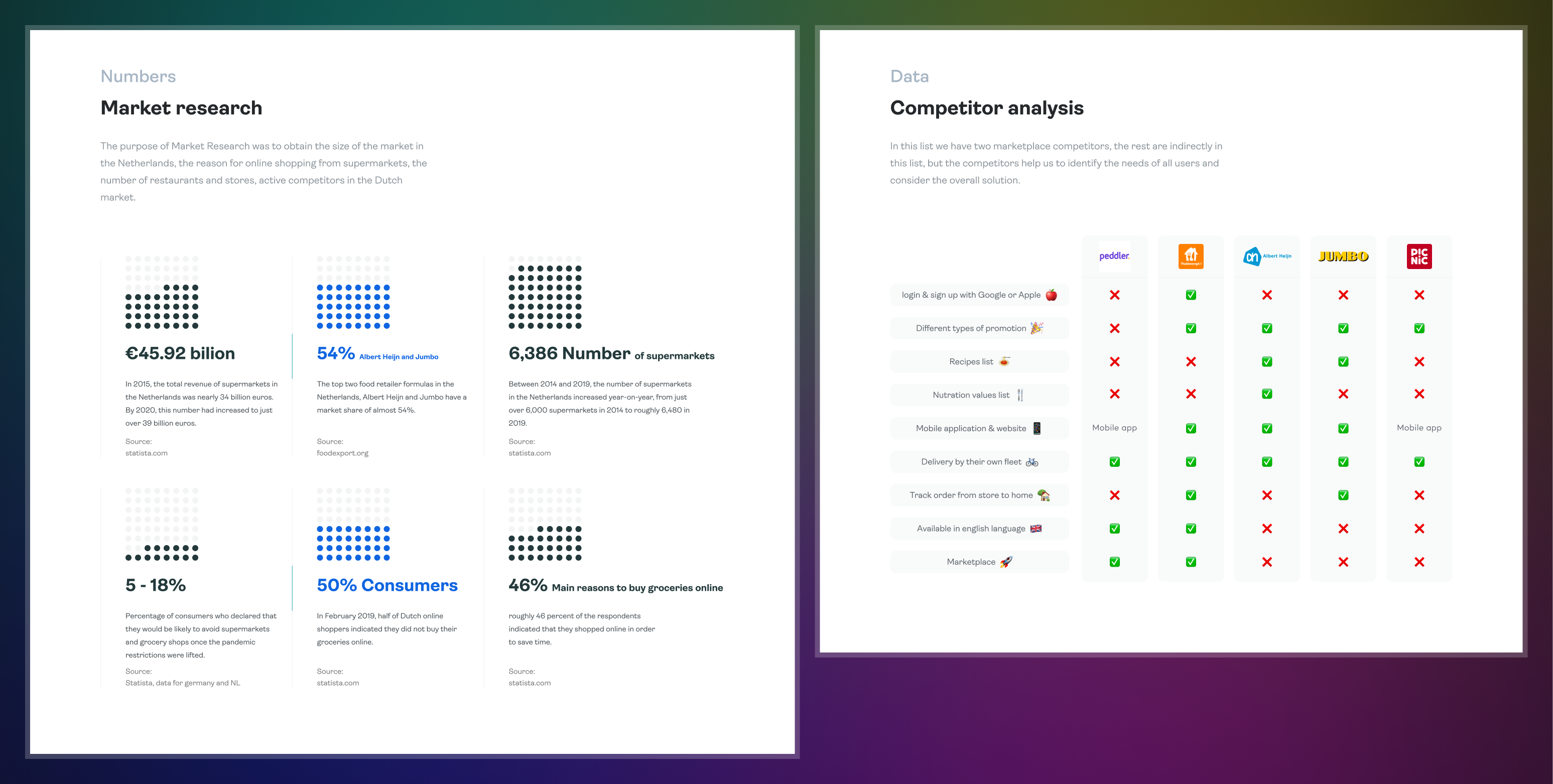
Our team has always placed a high priority on competitor analysis, and this is why we developed the website patterns by comparing ourselves to the ones we were inspired by, and then came up with a better version than they did. In order to simplify the flow of the website users go through, we tried to make it similar to the mobile flow, so that the user does not get confused and misunderstand the process as they go through it on the website.

During the development of this website, we tried to make sure that all the most important parts, such as tracking the order or completing the order process, were simple to use, and we succeeded in designing a simpler version that means less confusion for the user.

• Store mobile app
Although there were differences between the store owner mobile version and the dashboard, But the store owner did not seem to have a problem with how it worked or how it differed from the store owner mobile version.

There was an important feature in the store owner's mobile app and dashboard that allowed them to customize a customer's order to meet their needs. The store could have told the user that I have 3 products of A in stock, but you requested 5, so I could have said that I have 3 products. If the user accepts, the money for the two products will be returned to the user's wallet.
• Store dashboard
It was important to prioritize the most important parts of the store dashboard, and we made it as easy as we could for users to access them. We created a design in which the store owner was able to assign 20 products to any desired photo or category and then save the whole process in one minute. This was one of the most important things that we implemented.

It was very easy for store owners to update their stores and add products individually or in bulk, and this was done in a very straightforward manner.
04. Results
Unfortunately, the project did not succeed 😔
- New Users: A total of 1000 new users have been acquired within three months of the launch of the application.
- Adding multiple products: The success rate of using the feature of adding products in multiple by store owners was 73% when it came to using the feature.
- Task completion rate: After testing with five users, the order task completion rate for the customer app was 80% and for the web was 83%, according to the results of the usability testing.
Learnings 📖
After reviewing the feedback received from users, we learned the following:
- Simplicity is strength: Some of the users felt the order process was very easy to complete and were positively surprised about how quick and easy the process was.
- Technical problems: There is always a need to prioritize technical problems to be solved and, as much as possible, the team should try not to change its members too soon after the problems solved.
- Power of money: There is no way a startup can survive without the support of investors. A startup cannot survive without investments.
- Seek out feedback early and continually: In some instances, new store owners were not familiar with the concept of a "store within a digital platform" because they had no previous experience with this concept and would prefer to receive more information before making a decision.
- Pay attention to the details: always the smallest details in the design are very important and may even cause the user's flow to be messed up or lead to the user not using the app. Always listen to users to resolve issues they report.
Thank you 🙏



"Lorem ipsum dolor sit amet, consectetur adipiscing elit. Proin elementum sem neque, et posuere erat interdum vitae.”
Next Project